
Another front in Tallahassee’s us-versus-them culture wars…
Welcome to the beginning of the school year 2025…Our precious children here in Florida are now once again dealing with an extremely divisive political climate…
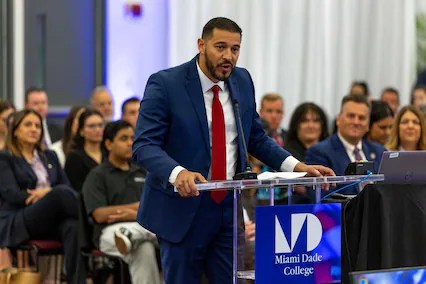
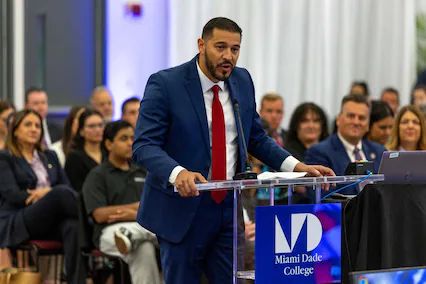
Anastasios Kamoutsas.,Gov. Ron DeSantis didn’t look far for his pick to be the new Florida commissioner of education.
On June 3, he recommended one of his top aides, deputy chief of staff Anastasios “Stasi” Kamoutsas, to replace Commissioner Manny Diaz Jr., who was elected a week prior to be interim president of the University of West Florida…
John Hill – Columnist
John Hill is a columnist for the Tampa Bay Times…
When did anger become a mode of governing? Threats a legitimate policy tool? Posting online a serious substitute for dialogue and engagement?
I ask because just a couple of months into his job, the state’s new education commissioner, Anastasios Kamoutsas, has managed to cheapen the quality of Florida’s political environment even further by picking fights over side issues that have more to do with dividing Floridians than with teaching our kids how to read and write…
The governor recommended Kamoutsas, his former aide, for the education commissioner’s post this year in the latest round of patronage hiring within Florida’s educational system. As the Tampa Bay Times’ Jeffrey S. Solochek reported recently, Kamoutsas has gained attention since taking office through his use of threats, warnings and public shaming aimed at local school board members, district officials and union leaders who he sees as insufficiently on board with the governor’s education agenda…
Kamoutsas telegraphed his style on day one, sending letters to school administrators warning them against violating the rights of parents or teachers. Do so, he advised, and: “I will be knocking on your door.”
He warned teacher unions not to use “delay tactics” in getting state-funded raises into teachers’ hands, even though no union had taken those steps. He accused the Alachua County school board of violating parents’ First Amendment rights at a board meeting, even though a review of the meeting shows that all residents were permitted to speak. Kamoutsas also targeted the Hillsborough County School District for a book the commissioner claimed was inappropriate; get rid of it immediately, he warned Superintendent Van Ayres in a social media post, “or you can expect another invite” before the state Board of Education.
The approach, as the Times aptly noted, mimics the behavior of the governor himself. But this wider circle of political appointees is increasingly following a similar playbook, making a splash with broad allegations of wrongdoing, inflammatory language about their supposed enemies and direct threats of punishment against those who don’t get in line.
When did this become an acceptable leadership style?
I’ve never seen a broader cast of unelected state leaders foster so much division among Floridians and distrust in our schools, courts, public health systems and other bedrock institutions. In Kamoutsas’ case, his nominal bosses at the state Board of Education make matters worse by flying high cover for such belligerence.
What are school districts, teachers, and parents to do?
First, appeasement doesn’t work. Hillsborough tried that and fell into a trap. School districts and the public need to push back, insisting that the state act within its authority and not broach upon the powers of individual school districts. Elections still matter; DeSantis can appoint failed school board candidates to the Board of Education if he wants, but that doesn’t mean the state assumes control of local educational systems.
Second, recognize that these cultural warriors are, for the most part, fighting yesterday’s battles and with limited success. There’s simply less appetite today, in the post-COVID area, for fanning public angst over supposed government overreach. What’s more, the ground is shifting on Florida’s efforts to restrict school materials and diversity policies; this month, a federal judge found the state’s crackdown on school books was overly broad, while another ruled that Florida’s law prohibiting teachers from using their preferred pronouns is discriminatory.
School districts caught in the state’s wrath need to ignore the drama, press for legal clarity if standoffs arise and refocus public attention on student needs and achievement. With the latest figures showing that more than 40% of Florida students cannot perform grade-level reading and math, Kamoutsas and the state Board of Education have more serious issues deserving of their time. Just ask the Florida Chamber of Commerce, which in December warned that the disconnect between Florida’s education system and its workforce “could impact the state’s long-term growth and economic stability.”
It’s a given that Florida voters will have varying priorities, and controlling the levers of government comes with winning elections. But I can’t think of any public good that comes with tolerating such a toxic atmosphere…

 Janis Sexton...Teacher...Advocate